Big Lizard Calculator
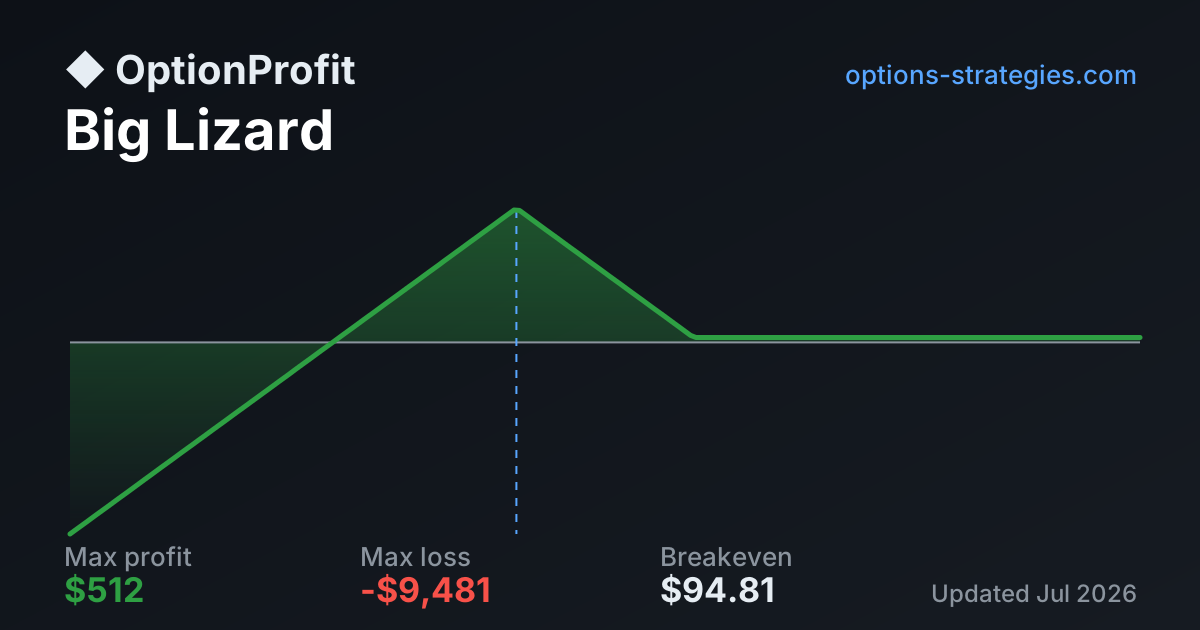
A big lizard sells an at-the-money straddle and buys an out-of-the-money call to cap the upside. When the credit collected is at least as large as the call-spread width, the upside risk disappears entirely — you keep premium if the stock stays near the strike, with risk only on the downside.
Interactive calculator
Edit the price, strikes and premiums to see the payoff update live.
Want probability of profit and live Greeks on real prices? Open the Big Lizard calculator →
⧉ Embed this free calculator on your site →
Key characteristics
- Sell the ATM call and put, buy an OTM call: a short straddle with the upside capped.
- If the credit ≥ the long call’s distance, there is no upside risk at all.
- Max profit is the net credit, kept when the stock pins the short strike.
- Downside risk remains from the short put — size it like a cash-secured put.
When to use a big lizard
Use it when you are neutral and want short-straddle income without the open-ended upside risk of a naked call. The long out-of-the-money call turns the unlimited upside into a defined, often zero, risk above the strike.
Traders size the long call so the premium collected covers its distance from the short strike — when that holds, the position simply cannot lose money to the upside, only to the downside if the stock falls.
Risks and management
The whole risk sits below. If the stock drops, the short put behaves like a cash-secured put and losses build, so keep enough capital to be assigned and manage the put if the stock breaks down.
As a short-volatility trade it is hurt by a big move down or an implied-volatility spike. It works best on range-bound names and is often closed early once most of the premium has decayed.
On the Greeks, the Big Lizard is vega-negative — a fall in implied volatility (such as an earnings IV crush) works in your favour, and theta-positive, so time decay adds to the position each day it is held.
Managing the trade and common mistakes
Experienced traders typically target 50 to 60 percent of maximum credit received as their profit exit on a Big Lizard. Because the position consists of a short straddle plus a long call that caps the upside risk, time decay works strongly in your favor once the underlying stays near the strike. When the trade moves in your favor early, resist the urge to hold until expiration: the remaining premium is rarely worth the jump risk that accelerates as expiration approaches. A tightening of implied volatility is another common trigger to close early, since the position was opened specifically to harvest elevated IV.
Rolling or adjusting a Big Lizard requires careful attention to the asymmetric risk profile. If the underlying drifts lower and the short put is threatened, rolling the entire spread down and out — moving to a lower strike and a further expiration — can reduce delta exposure while collecting additional credit. If the call side is challenged by a sharp upside move, the long call already provides a ceiling, so the adjustment priority should be the put. Cutting the loss is appropriate when the position has moved against you by roughly 100 percent of the initial credit received; letting losses run beyond that threshold destroys the statistical edge that makes the strategy viable over many occurrences.
Beginners consistently make three specific errors with the Big Lizard. First, they confuse the strategy with a plain short straddle and forget the long call is there to cap upside risk — then panic unnecessarily on a rally. Second, they underestimate pin risk at expiration: if the underlying closes exactly at the short strike, the short call and short put both expire worthless but the position may still carry undefined put exposure through the weekend. Third, liquidity matters more here than with single-leg trades because three contracts must be legged simultaneously; always use limit orders and price the spread as a package. Early assignment on the short put is uncommon but possible if the put trades deep in the money close to expiration, so monitor the extrinsic value of the short put in the final days.
Calculate it live
Use the free OptionProfit Big Lizard calculator to load a live option chain, build the trade, and instantly see the payoff chart, breakevens, probability of profit, Greeks and a Monte Carlo simulation of outcomes.
- A short ATM straddle with the upside capped by a long OTM call.
- No upside risk when the credit covers the long call’s distance.
- Max profit is the credit, at the short strike; risk is all on the downside.
- Treat the short put as a cash-secured commitment and manage breaks lower.
SPY, QQQ, IWM, AAPL, NVDA, AMZN, AMD, NFLX, MU, PLTR, SHOP, COIN, JPM, V
Frequently asked questions
Why is it called a big lizard?
It is the wider cousin of the jade lizard. A jade lizard sells a put plus a call spread; the big lizard sells the full ATM straddle and adds a long call to remove the upside risk.
Is there really no upside risk?
Only when the net credit you collect is at least the distance from the short strike to the long call. If you collect less than that width, a small capped upside loss remains.
Where do I lose money?
To the downside. The short put is unhedged below, so a falling stock is the real risk — exactly like holding a cash-secured put at the strike.
Long CallLong PutCovered CallCash Secured PutNaked PutBull Call SpreadBear Put SpreadBull Put Credit SpreadBear Call Credit SpreadIron CondorLong Call ButterflyLong StraddleLong StrangleCollarCall Calendar SpreadNaked CallCall Diagonal SpreadPut Calendar SpreadJade LizardBroken Wing ButterflyCall Ratio SpreadPut Ratio SpreadCall Ratio BackspreadPut Ratio BackspreadSynthetic Long StockStrapStripTwin PeaksKiteProtective PutShort StraddleShort StrangleSynthetic Short StockReverse Iron CondorReverse Iron ButterflyLong Call CondorDouble DiagonalZEBRA (Zero Extrinsic Back Ratio)Box SpreadRisk ReversalCovered StrangleLong GutsChristmas Tree ButterflyDiagonal Put SpreadConversionReversalCovered PutReverse Jade LizardStock RepairRatio Call WriteJelly RollDouble CalendarBull Call LadderBear Call LadderBull Put LadderBear Put LadderSeagull SpreadRatio Put WriteLong Put ButterflyLong Put CondorPut Broken Wing ButterflyPut Christmas Tree Butterfly
Educational use only. Quotes are delayed ~15 minutes and nothing here is financial advice. Options trading involves substantial risk of loss. Privacy Policy · Terms & Conditions.