Risk Reversal Calculator
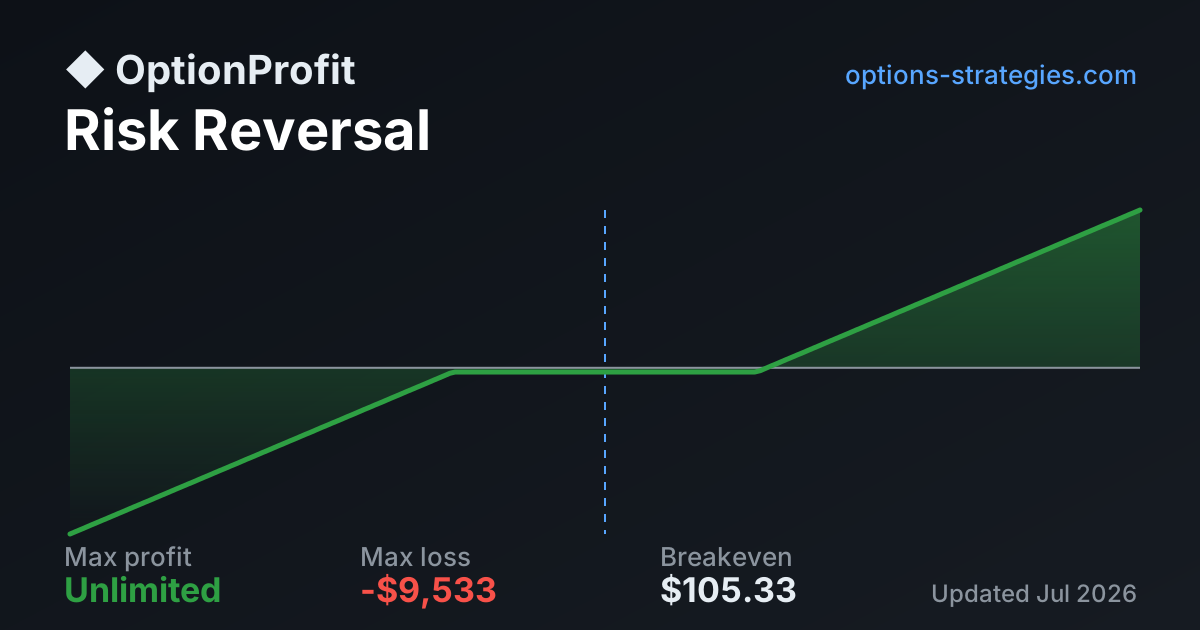
A risk reversal sells an out-of-the-money put to pay for a long out-of-the-money call. It is a leveraged bullish position — often near zero cost — that behaves like owning the stock, but with a flat "dead zone" between the two strikes and real downside risk below the short put.
Interactive calculator
Edit the price, strikes and premiums to see the payoff update live.
Want probability of profit and live Greeks on real prices? Open the Risk Reversal calculator →
⧉ Embed this free calculator on your site →
Key characteristics
- Sell an OTM put, buy an OTM call: a synthetic long-stock lean, frequently for little or no net cost.
- Upside is unlimited above the call strike; the short put funds the trade.
- Downside mirrors owning stock below the put strike — you can be assigned 100 shares there.
- Between the two strikes the P/L is roughly flat (the net credit or debit you opened for).
When to use a risk reversal
Use it when you are firmly bullish and want stock-like upside with little or no upfront cost, and you are genuinely willing to own the shares at the put strike if you are wrong. The premium from the short put pays for the long call, so the position is cheap to put on.
Strike selection sets the character: a wider gap lowers the cost (or creates a credit) but widens the flat dead zone where nothing happens; tighter strikes behave more like a straight long stock position.
Risks and management
The danger is the short put. A sharp drop forces you to buy 100 shares at the put strike, with losses building all the way down — this is not a defined-risk trade. Size it as if you were buying the stock outright.
Many traders close or roll the short put if the stock weakens, and take profits on the long call into a rally. Watch dividends and skew: puts are often richer than calls, which is exactly what makes the structure cheap.
On the Greeks, the Risk Reversal is close to vega-neutral, so implied-volatility shifts have little net effect.
Managing the trade and common mistakes
Once you are in a risk reversal, the position needs active monitoring precisely because there is no premium buffer to absorb a slow drift against you. Experienced traders typically take profits when the long call has captured a substantial portion of the expected move — often somewhere between 50 % and 75 % of the maximum theoretical gain — rather than holding through expiration and risking a reversal. Cutting the loss is equally systematic: because the short put can accumulate significant intrinsic value quickly in a sell-off, many traders define a delta threshold or an underlying price level before entry and exit the entire structure if that level is breached. Partial adjustments — for example, closing the short put leg independently when it becomes deep in-the-money — can reduce directional exposure without abandoning the long call entirely, but this converts the trade into a naked long call and removes the credit that may have funded the original entry.
Rolling is the most common adjustment when the trade moves against you but your bullish thesis remains intact. Rolling the short put down and out — buying back the existing put and selling a lower-strike put at a further expiration — reduces the immediate assignment risk and lowers the break-even on the downside, but it also extends the time you are committed to the position and the additional credit collected is often modest. If the underlying rises sharply and the long call is deep in-the-money, you can roll the call up and out to capture more upside, but evaluate whether the new call's delta justifies the cost of the roll. Avoid the common mistake of rolling repeatedly just to defer a loss; each roll that generates a net debit is simply paying to stay wrong.
The short put leg carries the most operationally dangerous nuance of this strategy: early assignment. Unlike the synthetic long stock where both legs are at the same strike, a risk reversal typically places the short put out-of-the-money at entry, which means assignment becomes a real risk only if the stock drops significantly — but when it does, the move tends to be fast and the put can go deep in-the-money before you react. Being assigned means you are suddenly long 100 shares per contract at the put strike while also holding the long call, creating unintended and leveraged long exposure. Ex-dividend dates amplify this risk substantially: a put that is even slightly in-the-money is a strong assignment candidate on the day before the ex-date. On the liquidity side, the bid-ask spread on each leg behaves independently near expiration; exiting as a spread order is usually more efficient than legging out, especially in lower-volume names.
Calculate it live
Use the free OptionProfit Risk Reversal calculator to load a live option chain, build the trade, and instantly see the payoff chart, breakevens, probability of profit, Greeks and a Monte Carlo simulation of outcomes.
- Leveraged bullish exposure for little or no cost — the short put pays for the long call.
- Unlimited upside, a flat zone between strikes, and stock-like risk below the put.
- Not defined risk: treat the short put as a commitment to buy 100 shares.
- Put skew makes it cheap; only use it when you truly want to own the stock lower.
META, GOOGL, AVGO, CRM, PYPL, BAC, WFC, GS, MA, GM, KO, WMT, SBUX, MARA
Frequently asked questions
Is a risk reversal the same as a synthetic long stock?
It is the same idea but with different strikes. A synthetic long uses the same strike for the call and put; a risk reversal spreads them apart (OTM call, OTM put), creating a flat zone in the middle and usually a lower cost.
How much can I lose?
A lot — the downside behaves like owning 100 shares from the put strike down to zero, minus any credit received. It is not a limited-risk position.
Why does it often cost almost nothing?
Because put implied volatility is usually higher than call IV (volatility skew), the OTM put you sell tends to bring in roughly what the OTM call you buy costs.
Long CallLong PutCovered CallCash Secured PutNaked PutBull Call SpreadBear Put SpreadBull Put Credit SpreadBear Call Credit SpreadIron CondorLong Call ButterflyLong StraddleLong StrangleCollarCall Calendar SpreadNaked CallCall Diagonal SpreadPut Calendar SpreadJade LizardBroken Wing ButterflyCall Ratio SpreadPut Ratio SpreadCall Ratio BackspreadPut Ratio BackspreadSynthetic Long StockStrapStripTwin PeaksKiteProtective PutShort StraddleShort StrangleSynthetic Short StockReverse Iron CondorReverse Iron ButterflyLong Call CondorDouble DiagonalZEBRA (Zero Extrinsic Back Ratio)Box SpreadCovered StrangleLong GutsChristmas Tree ButterflyDiagonal Put SpreadConversionReversalCovered PutBig LizardReverse Jade LizardStock RepairRatio Call WriteJelly RollDouble CalendarBull Call LadderBear Call LadderBull Put LadderBear Put LadderSeagull SpreadRatio Put WriteLong Put ButterflyLong Put CondorPut Broken Wing ButterflyPut Christmas Tree Butterfly
Educational use only. Quotes are delayed ~15 minutes and nothing here is financial advice. Options trading involves substantial risk of loss. Privacy Policy · Terms & Conditions.