Long Call Condor Calculator
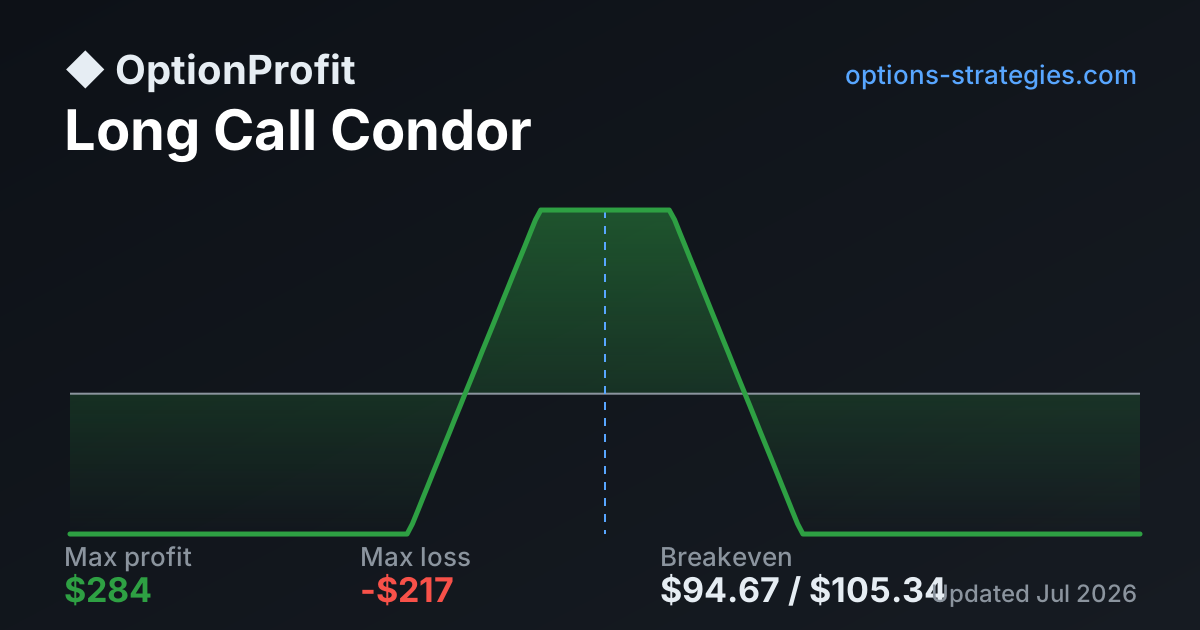
A long call condor buys a low and a high strike call and sells two middle strikes between them. It behaves like a butterfly with a flat top: a defined-risk, neutral trade that profits when the stock stays inside the two short strikes, built entirely from calls.
Interactive calculator
Edit the price, strikes and premiums to see the payoff update live.
Want probability of profit and live Greeks on real prices? Open the Long Call Condor calculator →
⧉ Embed this free calculator on your site →
Key characteristics
- Buy a low + high call, sell two inner calls between them: net debit.
- Profits across a price range between the inner strikes (a flat-top butterfly).
- Max loss = the debit; max profit = the strike spacing − debit.
- A neutral, range-bound trade — like an iron condor made only from calls.
When to use a long condor
Use a long condor when you expect the stock to drift sideways and stay within a band you can define with the two inner strikes. Compared with a butterfly it has a wider, flat profit zone (a plateau instead of a single peak), so you do not need to pin one exact price.
It is the same payoff shape as an iron condor but constructed from a single option type. Some traders prefer the all-call (or all-put) version for cleaner pricing or to avoid early-assignment quirks on one side.
Risk and trade-offs
Risk is strictly defined — the most you can lose is the net debit paid — and the reward is the spacing between adjacent strikes minus that debit. The wider you set the inner strikes, the larger the profit zone but the smaller the maximum profit.
As a debit, time decay generally helps once you are inside the range, but a strong directional move past either outer strike caps your loss at the debit. It rewards patience: you set the range and wait.
On the Greeks, the Long Call Condor is vega-negative — a fall in implied volatility (such as an earnings IV crush) works in your favour, and theta-positive, so time decay adds to the position each day it is held.
Managing the trade and common mistakes
Experienced traders typically target closing a long call condor when it reaches roughly 50 % of the maximum theoretical profit rather than holding into expiration. The final stretch is difficult: to achieve the maximum payoff, the underlying must stay inside both inner strikes at expiration, and slippage on four legs can easily erase what little edge remains. If the stock moves sharply in either direction soon after entry, exit while the legs you bought still carry extrinsic value. Rolling is rarely productive — the condor needs the underlying to settle in a specific band, and shifting the entire four-leg structure to a new range costs multiple bid-ask crossings and usually destroys any remaining edge.
The mistake beginners make most often is confusing the long call condor with a wide butterfly or an iron condor. The two inner strikes are not the same, so the profit zone is a flat plateau between the two short strikes, not a peak. Traders who do not understand this sometimes let the position sit while the stock drifts into the inner spread but does not reach the upper short strike — collecting less profit than expected. A second common error is selecting illiquid strikes: with four legs, a wide market on any single leg multiplies quickly into an expensive entry and exit, often making the theoretical edge fictional.
Assignment risk is concentrated on the two short calls whenever they go deep in-the-money, and with an American-style equity condor you can be assigned on either or both of them at any time before expiration, not just on the last day. If you are assigned on the lower short call while the corresponding long call has not been exercised, you hold short stock overnight. As expiration approaches and the underlying trades near either short strike, pin risk on that leg increases. The cleaner solution is always to close the entire four-leg structure as a single order rather than legging out, because partial closes often leave unhedged exposure that costs more to clean up than the saved commissions.
Calculate it live
Use the free OptionProfit Long Call Condor calculator to load a live option chain, build the trade, and instantly see the payoff chart, breakevens, probability of profit, Greeks and a Monte Carlo simulation of outcomes.
- Buy the outer calls, sell the two inner calls: a flat-top, range-bound trade.
- Defined risk (the debit) and a plateau of maximum profit between the shorts.
- Same shape as an iron condor, built from a single option type.
- Wider inner strikes = bigger profit zone but smaller max profit.
SPY, QQQ, IWM, AAPL, NVDA, AMD, NFLX, MU, SHOP, COIN, JPM, BAC, BA, F
Frequently asked questions
How is a long condor different from a butterfly?
A butterfly has a single peak at one strike; a condor spreads the body across two middle strikes, giving a flat top — a range of prices that all earn the maximum profit instead of one exact point.
Long condor vs iron condor?
They have the same payoff shape. A long call condor is built from four calls (a debit); an iron condor combines a put spread and a call spread (a credit). The risk/reward is equivalent; the construction and assignment details differ.
What is my maximum loss?
The net debit you paid. It happens when the stock finishes beyond either outer strike, where all the spreads cancel out.
Long CallLong PutCovered CallCash Secured PutNaked PutBull Call SpreadBear Put SpreadBull Put Credit SpreadBear Call Credit SpreadIron CondorLong Call ButterflyLong StraddleLong StrangleCollarCall Calendar SpreadNaked CallCall Diagonal SpreadPut Calendar SpreadJade LizardBroken Wing ButterflyCall Ratio SpreadPut Ratio SpreadCall Ratio BackspreadPut Ratio BackspreadSynthetic Long StockStrapStripTwin PeaksKiteProtective PutShort StraddleShort StrangleSynthetic Short StockReverse Iron CondorReverse Iron ButterflyDouble DiagonalZEBRA (Zero Extrinsic Back Ratio)Box SpreadRisk ReversalCovered StrangleLong GutsChristmas Tree ButterflyDiagonal Put SpreadConversionReversalCovered PutBig LizardReverse Jade LizardStock RepairRatio Call WriteJelly RollDouble CalendarBull Call LadderBear Call LadderBull Put LadderBear Put LadderSeagull SpreadRatio Put WriteLong Put ButterflyLong Put CondorPut Broken Wing ButterflyPut Christmas Tree Butterfly
Educational use only. Quotes are delayed ~15 minutes and nothing here is financial advice. Options trading involves substantial risk of loss. Privacy Policy · Terms & Conditions.