Ratio Call Write Calculator
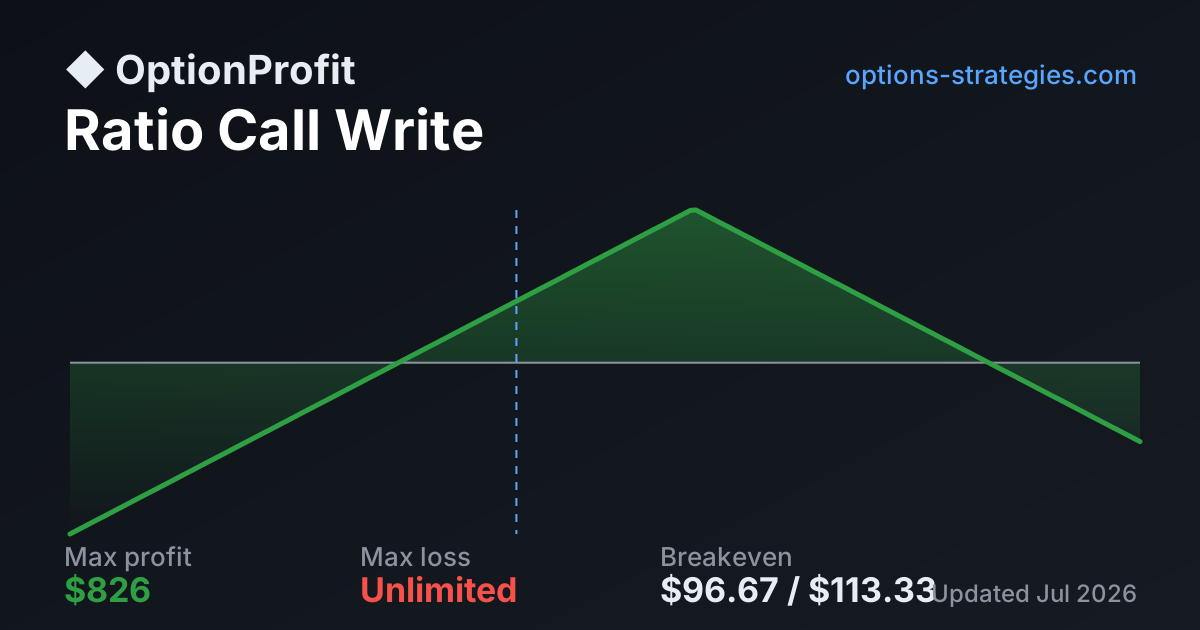
A ratio call write owns 100 shares and sells two calls against them. One call is covered by the stock, the other is naked, so you collect double the premium of a covered call — but you take on uncapped risk if the stock rallies through the strike.
Interactive calculator
Edit the price, strikes and premiums to see the payoff update live.
Want probability of profit and live Greeks on real prices? Open the Ratio Call Write calculator →
⧉ Embed this free calculator on your site →
Key characteristics
- Own 100 shares + sell 2 calls: double the premium of a covered call.
- Best on a flat or slowly drifting stock you expect to stall near the strike.
- Max profit at the strike = (strike − cost) × 100 + both premiums.
- Uncapped risk above the upper breakeven — one short call is naked.
When to use a ratio call write
Use it when you own a stock you expect to go sideways or rise only gently to a level where you would happily sell. Selling two calls instead of one maximises income and pushes your peak profit to that strike.
It is an aggressive overwrite: the extra short call is uncovered, so the position trades higher income today for real risk if the stock breaks out above your strike.
Risks and management
The danger is a rally. Above the upper breakeven the naked short call loses faster than the stock gains, producing theoretically unlimited losses — this is not a defined-risk position despite owning the shares.
Manage it by rolling the short calls up and out if the stock approaches the strike, or by buying back one call to revert to a plain covered call. Avoid it into earnings or any event that could gap the stock higher.
On the Greeks, the Ratio Call Write is vega-negative — a fall in implied volatility (such as an earnings IV crush) works in your favour, and theta-positive, so time decay adds to the position each day it is held.
Managing the trade and common mistakes
Managing a ratio call write demands more active attention than a plain covered call because the uncovered short calls create open-ended upside risk the moment the stock rallies past the short strike. Experienced traders take profits when the position has decayed to roughly 20–25 % of the initial net credit — harvesting the last slice of theta is not worth the convexity risk of holding naked short calls near expiration. If the stock drifts in a narrow range, the position can often be left to expire, but any meaningful rally should prompt a reassessment before the uncovered legs go deep in the money. A disciplined rule — such as closing or rolling when the net loss reaches twice the original credit — keeps the trade from evolving into an unhedged directional bet.
Rolling the uncovered short calls up and out is the classic adjustment when the stock rises toward the strike, but it comes at a cost: the roll typically requires paying a debit, which erodes or eliminates the credit collected at entry. Beginners frequently wait too long, hoping the stock will reverse, and by then the debit required to roll is painfully large or a credit roll is no longer available at all. The more common mistake, though, is forgetting that the ratio write carries a built-in profit ceiling — many newcomers add uncovered short calls to boost income but fail to account for the loss profile above the short strike, where gains from the covered portion are fully offset and the naked legs bleed linearly.
Assignment on the uncovered short calls can arrive at any time the calls are in the money, not just at expiration. Early assignment is most likely when extrinsic value is near zero and an ex-dividend date is approaching — the call holder has an incentive to exercise early to capture the dividend, leaving you short shares with no hedge and unexpected margin exposure. At expiration, any call even slightly in the money will be exercised automatically, so allow extra time to close or roll the uncovered legs rather than relying on pin risk working in your favour. Liquidity deserves attention too: the two short calls are each a separate fill, and wide bid-ask spreads can make closing under stress significantly more expensive than the original credit justified.
Calculate it live
Use the free OptionProfit Ratio Call Write calculator to load a live option chain, build the trade, and instantly see the payoff chart, breakevens, probability of profit, Greeks and a Monte Carlo simulation of outcomes.
- A covered call plus an extra naked call — double premium, real risk.
- Peak profit at the short strike; income cushions a small move.
- Uncapped losses above the upper breakeven from the naked call.
- Roll up or buy one back if the stock threatens to break out.
SPY, QQQ, IWM, AAPL, NVDA, AMZN, AMD, NFLX, MU, PLTR, SHOP, COIN, JPM, V
Frequently asked questions
How is this different from a covered call?
A covered call sells one call against 100 shares. A ratio call write sells two, so only one is covered — the second is naked, doubling income but adding uncapped upside risk.
When do I lose money?
On a strong rally. Past the upper breakeven the uncovered short call loses faster than your shares gain, so the position has theoretically unlimited risk to the upside.
Can I make it safer?
Yes — buy back one of the calls to return to a standard covered call, or roll both calls up and out to a higher strike as the stock rises.
Covered Call vs Cash-Secured PutTheta Decay & Selling PremiumImplied Volatility Explained
Long CallLong PutCovered CallCash Secured PutNaked PutBull Call SpreadBear Put SpreadBull Put Credit SpreadBear Call Credit SpreadIron CondorLong Call ButterflyLong StraddleLong StrangleCollarCall Calendar SpreadNaked CallCall Diagonal SpreadPut Calendar SpreadJade LizardBroken Wing ButterflyCall Ratio SpreadPut Ratio SpreadCall Ratio BackspreadPut Ratio BackspreadSynthetic Long StockStrapStripTwin PeaksKiteProtective PutShort StraddleShort StrangleSynthetic Short StockReverse Iron CondorReverse Iron ButterflyLong Call CondorDouble DiagonalZEBRA (Zero Extrinsic Back Ratio)Box SpreadRisk ReversalCovered StrangleLong GutsChristmas Tree ButterflyDiagonal Put SpreadConversionReversalCovered PutBig LizardReverse Jade LizardStock RepairJelly RollDouble CalendarBull Call LadderBear Call LadderBull Put LadderBear Put LadderSeagull SpreadRatio Put WriteLong Put ButterflyLong Put CondorPut Broken Wing ButterflyPut Christmas Tree Butterfly
Educational use only. Quotes are delayed ~15 minutes and nothing here is financial advice. Options trading involves substantial risk of loss. Privacy Policy · Terms & Conditions.