Naked Put Calculator
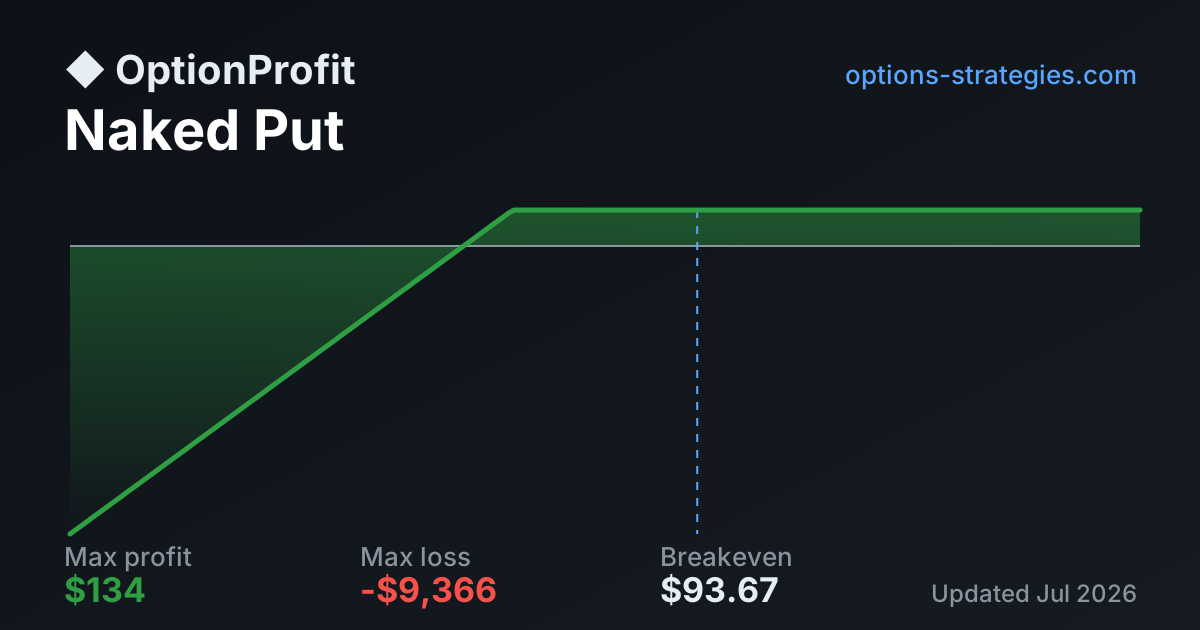
A naked (short) put sells a put to collect premium without setting cash aside. It profits if the stock stays above the strike, with substantial risk if it falls sharply.
Interactive calculator
Edit the price, strikes and premiums to see the payoff update live.
Want probability of profit and live Greeks on real prices? Open the Naked Put calculator →
⧉ Embed this free calculator on your site →
Key characteristics
- Max profit = premium received. Loss grows as the stock falls below the strike.
- Breakeven = strike − premium.
- Higher margin requirement and risk than a cash-secured put.
How it differs from a cash-secured put
A naked put has the same payoff shape as a cash-secured put, but you do not set the full cash aside — the broker holds margin instead. That leverage boosts return on capital but magnifies risk if the stock falls.
Because the position is margined rather than cash-backed, a sharp decline can trigger a margin call, forcing you to add funds or close at a loss.
Risks and management
Your loss grows as the stock falls below the strike, all the way down (a stock can in theory go to zero), offset only by the premium collected. This is not a beginner trade.
Manage it with strict position sizing, and consider buying a cheap further-OTM put to convert it into a defined-risk bull put credit spread.
On the Greeks, the Naked Put is vega-negative — a fall in implied volatility (such as an earnings IV crush) works in your favour, and theta-positive, so time decay adds to the position each day it is held.
Managing the trade and common mistakes
Most experienced traders close a naked put early once it has captured roughly 50–80 % of the maximum credit. Theta decay accelerates as expiration approaches, but so does gamma risk — a sharp move against you in the final days can erase weeks of premium collection in hours. If the put moves deep in-the-money and you still believe in the underlying, rolling down and out (buying back the current put and selling one at a lower strike in a further expiration) buys time and collects additional credit. If the thesis has changed, taking the loss and moving on is almost always preferable to doubling down.
The most common mistake beginners make is treating the naked put as a 'free money' trade because the probability of profit appears high at entry. They sell far too much notional exposure relative to account size, then freeze when the stock sells off. Position sizing is everything: a single naked put controls 100 shares, so the real risk is equivalent to owning that stock outright with no downside hedge. A second mistake is ignoring implied volatility — selling a put when IV is depressed means collecting a thin premium for substantial risk.
Assignment is not a risk to fear if you are prepared for it, but surprises do happen. A naked put can be assigned early if the option goes deep in-the-money and the remaining extrinsic value falls near zero, particularly around ex-dividend dates when early exercise becomes rational for the put holder. If you are not willing or able to take delivery of 100 shares per contract, you must close or roll before that point. Also watch bid-ask spreads: illiquid puts can carry wide spreads that make rolling expensive and turn a theoretical profit into a realized loss.
Calculate it live
Use the free OptionProfit Naked Put calculator to load a live option chain, build the trade, and instantly see the payoff chart, breakevens, probability of profit, Greeks and a Monte Carlo simulation of outcomes.
- Same payoff as a cash-secured put but margined, not cash-backed.
- Higher return on capital, higher risk and possible margin calls.
- Loss grows as the stock falls; breakeven = strike − premium.
- Add a long put to define the risk (a credit spread).
META, GOOGL, AVGO, CRM, PLTR, WFC, GS, MA, KO, WMT, SBUX, XOM, BABA, MARA
Frequently asked questions
Is a naked put riskier than a cash-secured put?
The payoff is identical, but the naked put uses leverage, so the same loss hits a smaller capital base and can trigger margin calls.
How do I limit the risk?
Buy a cheaper put below your strike to cap the downside — that turns it into a defined-risk bull put credit spread.
Should beginners sell naked puts?
No. Beginners should use cash-secured puts or defined-risk spreads until they fully understand the leverage and assignment risk.
Probability of Profit & Expected MoveCredit vs Debit SpreadsCommon Options Trading Mistakes
Long CallLong PutCovered CallCash Secured PutBull Call SpreadBear Put SpreadBull Put Credit SpreadBear Call Credit SpreadIron CondorLong Call ButterflyLong StraddleLong StrangleCollarCall Calendar SpreadNaked CallCall Diagonal SpreadPut Calendar SpreadJade LizardBroken Wing ButterflyCall Ratio SpreadPut Ratio SpreadCall Ratio BackspreadPut Ratio BackspreadSynthetic Long StockStrapStripTwin PeaksKiteProtective PutShort StraddleShort StrangleSynthetic Short StockReverse Iron CondorReverse Iron ButterflyLong Call CondorDouble DiagonalZEBRA (Zero Extrinsic Back Ratio)Box SpreadRisk ReversalCovered StrangleLong GutsChristmas Tree ButterflyDiagonal Put SpreadConversionReversalCovered PutBig LizardReverse Jade LizardStock RepairRatio Call WriteJelly RollDouble CalendarBull Call LadderBear Call LadderBull Put LadderBear Put LadderSeagull SpreadRatio Put WriteLong Put ButterflyLong Put CondorPut Broken Wing ButterflyPut Christmas Tree Butterfly
Educational use only. Quotes are delayed ~15 minutes and nothing here is financial advice. Options trading involves substantial risk of loss. Privacy Policy · Terms & Conditions.