Reverse Jade Lizard Calculator
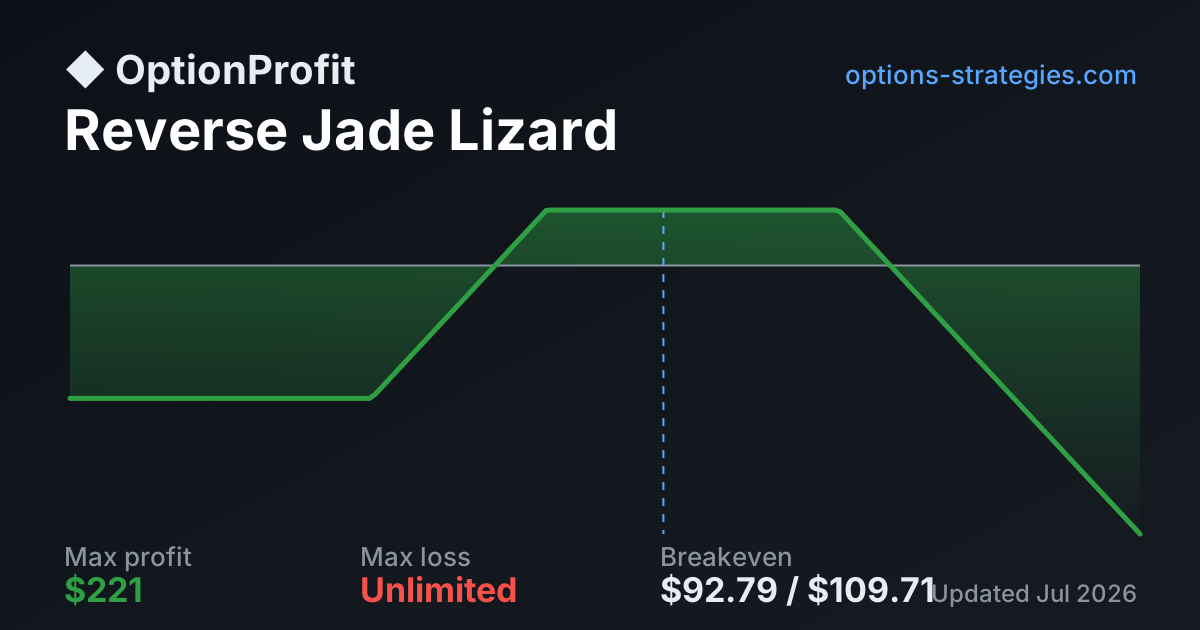
A reverse jade lizard sells an out-of-the-money call and a bull put spread below the price. It is the mirror of the jade lizard: when the credit collected is at least the width of the put spread, the downside risk vanishes, leaving only upside risk from the short call.
Interactive calculator
Edit the price, strikes and premiums to see the payoff update live.
Want probability of profit and live Greeks on real prices? Open the Reverse Jade Lizard calculator →
⧉ Embed this free calculator on your site →
Key characteristics
- Sell an OTM call + a bull put spread (short higher put, long lower put): a net credit.
- If the credit ≥ the put-spread width, there is no downside risk at all.
- Profits if the stock stays between the breakevens; max profit is the credit.
- Risk is to the upside, from the single short call above the price.
When to use a reverse jade lizard
Use it when you are neutral to slightly bearish and want premium income with the downside fully defined. The bull put spread caps the risk below, and structuring the trade for a large enough credit removes that downside risk entirely.
It is the exact mirror of a jade lizard, which removes upside risk instead. Choose the reverse version when you are more worried about a drop than a rally and prefer your defined-risk wall underneath the price.
Risks and management
The exposure is the short call above. A sharp rally is the danger — the single short call is unhedged on the upside, so a big move up can produce large losses, much like a naked call.
Manage it by rolling the short call up and out if the stock rallies, and take profits once the premium has mostly decayed. As a short-volatility trade, avoid opening it when implied volatility is already low and a move is likely.
On the Greeks, the Reverse Jade Lizard is vega-negative — a fall in implied volatility (such as an earnings IV crush) works in your favour, and theta-positive, so time decay adds to the position each day it is held.
Managing the trade and common mistakes
Experienced traders typically target 50 to 70 percent of the maximum credit received as a profit-taking threshold. Because the reverse jade lizard collects premium from a short call spread while simultaneously buying a put, the tent-shaped profit zone is widest near the short call strike. Once the underlying has drifted toward that sweet spot and time decay has done its work, closing the entire structure in one order removes pin risk and locks in the gain cleanly. Many traders set a good-till-cancelled limit order the moment they open the trade so emotion never enters the exit decision. The put leg and the call spread must always be closed together; legging out creates a residual naked exposure that defeats the whole design.
Rolling and adjusting this structure requires care because the put and the call spread do not behave symmetrically. If the stock rallies hard and threatens the short call, the natural adjustment is to roll the entire call spread up and out to a later expiry, collecting additional credit and raising the upper boundary of the profit zone. If the stock drops sharply and the long put gains intrinsic value, some traders roll the put down to capture more downside premium or simply close the put leg at a profit while leaving the call spread to decay. A hard stop is warranted when the debit to close the full position reaches roughly 150 to 200 percent of the original credit, signalling the trade thesis has broken down and further patience will only deepen the loss.
Beginners make three recurring errors with the reverse jade lizard. First, they size the position relative only to the net credit without accounting for the full width of the call spread, which is the true capital at risk on the upside. Second, they forget that the long put can be assigned early if it goes deep in-the-money on an ex-dividend date or during a short squeeze, forcing an unwanted long stock position at an inopportune moment. Third, they hold through expiration hoping for maximum profit, but near expiry the gamma on both the put and the short call spikes, creating outsized moves from small underlying wiggles. Closing several days before expiration sidesteps that whipsaw entirely, and it also sidesteps the liquidity problem: bid-ask spreads on individual legs tend to widen sharply in the final days, making exits expensive.
Calculate it live
Use the free OptionProfit Reverse Jade Lizard calculator to load a live option chain, build the trade, and instantly see the payoff chart, breakevens, probability of profit, Greeks and a Monte Carlo simulation of outcomes.
- The mirror of a jade lizard: short call + put spread, no downside risk.
- Achieved when the credit collected covers the put-spread width.
- Profit zone is a wide band; max profit is the net credit.
- Upside risk only — manage or roll the short call on a rally.
SPY, QQQ, IWM, AAPL, NVDA, AMZN, AMD, NFLX, MU, PLTR, SHOP, COIN, JPM, V
Frequently asked questions
How is this different from a jade lizard?
A jade lizard sells a put plus a call spread and has no upside risk. The reverse jade lizard sells a call plus a put spread and has no downside risk — it is the mirror image.
When is there truly no downside risk?
When the total credit you collect is at least the width of the bull put spread. Then even at zero the put spread’s loss is fully offset by the premium.
What is the worst case?
A strong rally. The lone short call above the price is unhedged, so the upside loss can be large — treat that call like a naked short call for sizing.
Long CallLong PutCovered CallCash Secured PutNaked PutBull Call SpreadBear Put SpreadBull Put Credit SpreadBear Call Credit SpreadIron CondorLong Call ButterflyLong StraddleLong StrangleCollarCall Calendar SpreadNaked CallCall Diagonal SpreadPut Calendar SpreadJade LizardBroken Wing ButterflyCall Ratio SpreadPut Ratio SpreadCall Ratio BackspreadPut Ratio BackspreadSynthetic Long StockStrapStripTwin PeaksKiteProtective PutShort StraddleShort StrangleSynthetic Short StockReverse Iron CondorReverse Iron ButterflyLong Call CondorDouble DiagonalZEBRA (Zero Extrinsic Back Ratio)Box SpreadRisk ReversalCovered StrangleLong GutsChristmas Tree ButterflyDiagonal Put SpreadConversionReversalCovered PutBig LizardStock RepairRatio Call WriteJelly RollDouble CalendarBull Call LadderBear Call LadderBull Put LadderBear Put LadderSeagull SpreadRatio Put WriteLong Put ButterflyLong Put CondorPut Broken Wing ButterflyPut Christmas Tree Butterfly
Educational use only. Quotes are delayed ~15 minutes and nothing here is financial advice. Options trading involves substantial risk of loss. Privacy Policy · Terms & Conditions.