Bull Put Credit Spread Calculator
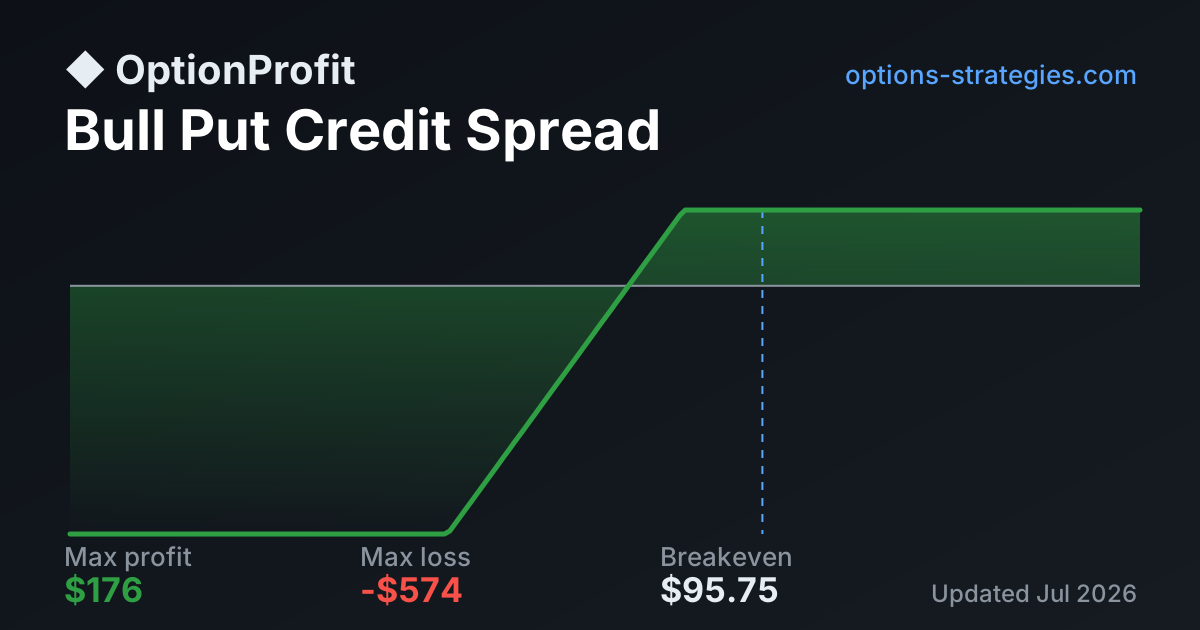
A bull put credit spread sells a put and buys a lower-strike put for protection, collecting a net credit. It profits if the stock stays above the short strike — a high-probability income trade.
Interactive calculator
Edit the price, strikes and premiums to see the payoff update live.
Want probability of profit and live Greeks on real prices? Open the Bull Put Credit Spread calculator →
⧉ Embed this free calculator on your site →
Key characteristics
- Max profit = net credit received. Max loss = strike width − credit.
- Breakeven = short put strike − credit.
- A defined-risk, high-probability premium-selling strategy.
When to use a bull put credit spread
Use it when you are neutral-to-bullish and want to be paid for the stock simply staying above a level. You sell a put and buy a lower-strike put for protection, collecting a net credit you keep if the stock holds.
It works best when implied volatility is elevated (richer credit) and you can pick a short strike below support, giving the trade a high probability of profit.
Risks and management
Maximum profit is the credit; maximum loss is the strike width minus the credit, reached if the stock falls below the long strike. The reward is smaller than the risk, so the high hit-rate must hold up over time.
Many sellers close at around 50% of max profit, and defend a tested spread by rolling it down and out for additional credit rather than letting it run to expiration.
On the Greeks, the Bull Put Credit Spread is vega-negative — a fall in implied volatility (such as an earnings IV crush) works in your favour, and theta-positive, so time decay adds to the position each day it is held.
Managing the trade and common mistakes
Most experienced sellers do not hold a bull put credit spread to expiration. Once the position has decayed to roughly 50% of the original credit — meaning you can buy it back for half what you collected — theta has done most of its work and the remaining reward no longer justifies the gamma risk of the final weeks. Closing early also frees up buying power and removes the possibility of a last-minute reversal turning a winner into a loser. If the stock moves strongly in your favour early in the trade, some traders tighten that target to 25–30% of max profit and close even sooner.
Rolling is the standard defence when the short put is tested. If the stock drifts toward your short strike with meaningful time remaining, you can buy back the entire spread and re-sell it at a lower strike and a later expiration for a net credit — 'rolling down and out.' The goal is to collect enough additional credit to lower your breakeven without widening your maximum loss. What you must avoid is rolling purely to 'avoid taking the loss': if you have already been assigned or the spread is deep in the money with little extrinsic value left, rolling usually locks in a larger net loss over time. Cut the position when the original thesis is clearly wrong — stock broke convincingly through your short strike and support — rather than defending indefinitely.
The assignment nuance that catches beginners off guard is that only the short put can be assigned, and it can happen early on American-style equity options. Early assignment typically happens when the short put trades deep in the money and has little extrinsic value left, or around an ex-dividend date if the put holder decides to exercise to capture the dividend. If you are assigned on the short put, you will be long 100 shares per contract at the short strike; your long put still protects you. The cleanest response is to exercise the long put immediately to flatten the position rather than carrying overnight stock risk. On the liquidity side, always enter and exit with a limit order on the spread as a single unit — legging in or out of each option separately creates execution risk and almost always results in a worse net price.
Calculate it live
Use the free OptionProfit Bull Put Credit Spread calculator to load a live option chain, build the trade, and instantly see the payoff chart, breakevens, probability of profit, Greeks and a Monte Carlo simulation of outcomes.
- Get paid if the stock stays above the short strike.
- Max profit = credit; max loss = strike width − credit.
- Breakeven = short put strike − credit.
- Favoured in high IV; manage at ~50% profit.
META, GOOGL, AVGO, CRM, PLTR, GS, SBUX, XOM, BABA, MARA, GME, RIVN, TSM, LLY
Frequently asked questions
What is the maximum I can lose?
The strike width minus the credit received — the long put caps your risk, so there are no open-ended losses.
Why is the potential loss bigger than the gain?
That is typical of high-probability credit spreads: you trade a larger risk for a high chance of a small win, so risk management matters.
When should I close it?
Many traders take profit around 50% of the maximum credit, or roll the spread down and out if the stock threatens the short strike.
Credit vs Debit SpreadsProbability of Profit & Expected MoveTheta Decay & Selling Premium
Long CallLong PutCovered CallCash Secured PutNaked PutBull Call SpreadBear Put SpreadBear Call Credit SpreadIron CondorLong Call ButterflyLong StraddleLong StrangleCollarCall Calendar SpreadNaked CallCall Diagonal SpreadPut Calendar SpreadJade LizardBroken Wing ButterflyCall Ratio SpreadPut Ratio SpreadCall Ratio BackspreadPut Ratio BackspreadSynthetic Long StockStrapStripTwin PeaksKiteProtective PutShort StraddleShort StrangleSynthetic Short StockReverse Iron CondorReverse Iron ButterflyLong Call CondorDouble DiagonalZEBRA (Zero Extrinsic Back Ratio)Box SpreadRisk ReversalCovered StrangleLong GutsChristmas Tree ButterflyDiagonal Put SpreadConversionReversalCovered PutBig LizardReverse Jade LizardStock RepairRatio Call WriteJelly RollDouble CalendarBull Call LadderBear Call LadderBull Put LadderBear Put LadderSeagull SpreadRatio Put WriteLong Put ButterflyLong Put CondorPut Broken Wing ButterflyPut Christmas Tree Butterfly
Educational use only. Quotes are delayed ~15 minutes and nothing here is financial advice. Options trading involves substantial risk of loss. Privacy Policy · Terms & Conditions.